When One AI Agent Isn't Enough
We design multi-agent systems where specialized agents plan, research, execute, and review each other's work — automating workflows a single prompt can't handle.
Architect -> Coder -> QA -> DevOps: 100% Zero-human intervention code deploy.
Multi-agent systems work together like a team - smarter, faster, and more reliable.
About the Multi-Agent Systems / Workflows
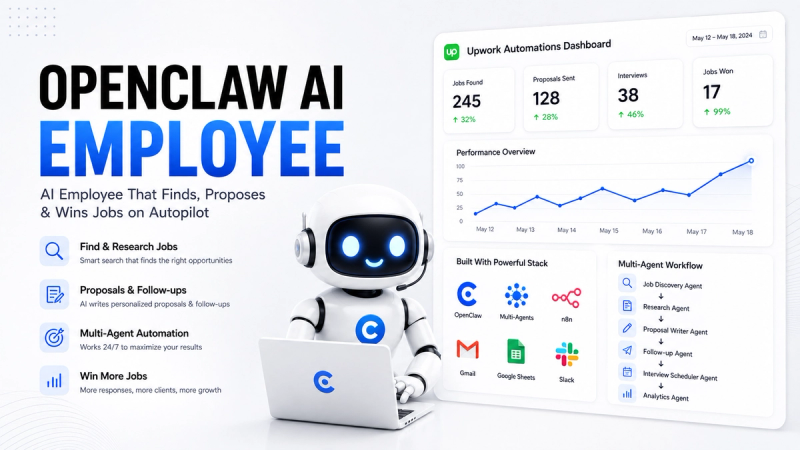
One agent is good at one job. Real business workflows are rarely one job — they're research, then drafting, then review, then execution, often across systems. Our AI Employee (built on OpenClaw) runs 24/7 finding relevant freelance jobs, matching them to skill sets, and drafting proposals — a full pipeline, not a single prompt.
The engineering challenge isn't getting one agent to work; it's getting agents to hand off reliably, stay inside cost and scope limits, and fail safely. We build monitoring and human-handoff paths in from day one, not bolted on after an incident.
This is worth it once a workflow has genuinely distinct stages needing different context or tools. If a single well-prompted agent or a straightforward n8n workflow already covers it, that's what we'll recommend — orchestration complexity you don't need is just cost you don't need.
Everything You Get With Multi-Agent Systems / Workflows
Orchestrated Agent Teams with Subagents
Agent-to-Agent Handoff Systems
Human-in-the-Loop Workflows
Cross-Functional Business Agent Stacks
Autonomous Task Decomposition
Cost & Step-Count Limits
Run Logs & Audit Trails
Monitoring & Failure Guardrails
Where Multi-Agent Systems / Workflows Fits
Research & Analysis Teams
Research, drafting, and review happen as one connected system instead of four tools stitched together by hand.
Ops-Heavy Teams
More volume doesn't mean more hires specialized agents scale the work without scaling headcount.
Quality-Sensitive Workflows
A dedicated review agent checks the output before it ships, not after a client catches the mistake.
Complex, Multi-Step Processes
Workflows that need real judgment across multiple steps finally get a system built for that complexity.
Production AI Systems In Action
Multi-Agent Systems / Workflows case studies from real engagements, published as projects complete.
OpenClaw Applications
AI Employee That Runs My Freelance Business
An AI employee built on OpenClaw that runs 24/7 handling freelance business operations: it finds matching Upwork jobs and drafts tailored proposals.
How We Build It
Workflow Mapping & Agent Role Design
We map the workflow end-to-end and decide which parts genuinely need a specialized agent versus a simple automation step.
Orchestration Architecture
We choose the orchestration framework and design what tools and data each agent can access — and, just as important, what it can't.
Agent Build & Inter-Agent Testing
Agents are built and tested together, not in isolation, since most failures happen at the handoff between agents.
Deployment & Monitoring
We deploy with run logs, cost monitoring, and human-handoff paths for when the system hits something it shouldn't handle alone.
Real Tools, Not a Buzzword List
Common Questions
Quick answers about our multi-agent systems / workflows services.
A single assistant handles one conversation at a time with one set of instructions. A multi-agent system splits a workflow into specialized roles — research, execution, review — that coordinate with each other, which is what makes it possible to automate genuinely multi-step processes.
Hard limits on tool access, step counts, and budget per run, plus monitoring that flags runs that go off-script — we design guardrails in from the start, not after something goes wrong.
We select the orchestration approach based on the workflow's complexity rather than defaulting to one framework for everything — this gets scoped during the architecture phase.
Each agent's output is validated before the next step runs, and failures route to a defined fallback — a retry, a simpler path, or a human handoff — instead of silently propagating bad output downstream.
How We Handle Your Data
Your Data Stays Yours
Your data, conversations, and documents are used only to build and run the system you're paying for - never to train third-party models, and never shared outside your project.
You Own What We Build
The code, prompts, and configurations built for your engagement belong to you, not licensed back to you after the contract ends.
Documented Upfront, Not Boilerplate
Hosting region, data retention windows, and who has access are scoped to your specific engagement and documented during discovery, not left as generic fine print.
Multi-Agent Systems / Workflows Packages
Starting points for a multi-agent systems / workflows engagement. Every project is scoped precisely after a discovery call.
Starter
A focused, single-scope multi-agent systems build
starting at, one-time project
- 2 Agents support
- Orchestration ( AgentA -> AgentB )
- Basic Execution Logs
- 1 business workflow
- Up to 2 external integrations
- Basic shared context/memory & guardrails
- Build, testing, and launch
- Depolyed + 3 weeks support
Growth
Multi-Agent Systems plus ongoing iteration and support
starting at, one-time project
- 3 to 5 Agents support
- Orchestration based on logic +routing
- Performance analytics Dashbord
- Multiple Business workflow
- upto 3 CRM integrations
- RAG / knowldge Base ( upto 10 to 20 pages )
- Production infrastructure + Security/guardrails
- Depolyed + 3 Week Support
Enterprise
Complex, multi-system builds and dedicated teams
scoped after discovery
- 6+ Agents support
- Multi-agent orchestration + Human in a Loop
- Complex workflows design within scope
- Custom CRM integrations + Channels
- Voice-agent integration
- Rag + Tool calling
- Production infrastructure + context/memory & guardrails
- Depolyed + full month Support
Illustrative starting points, not fixed quotes. Final pricing depends on the specific integration complexity and timeline.
Related Services
Learn More About Multi-Agent Systems / Workflows
Single-Agent vs. Multi-Agent AI Systems: How to Decide
A practical decision framework for choosing between a single AI agent and a multi-agent system, based on task complexity and coordination overhead.
Read the articlen8n vs. Zapier vs. Make: Which Automation Platform Should You Use?
n8n, Zapier, and Make all connect your tools together, but they diverge on cost, control, and complexity. Here's how to actually pick between them.
Read the articleWhat Is Claude Code? A Guide for Engineering Teams
Claude Code is Anthropic's agentic coding tool: it reads, writes, and runs code in your repo. Here's what that means for an engineering team.
Read the articleReady to talk about multi-agent systems / workflows?
Tell us what you're trying to build - we'll scope it and get back to you.